

SAS Lecture: The Grand Tour of Ice Giant aurorae: JWST’s transformational observations of Uranus and Neptune
About this event :
Professor Tom Stallard (Northumbria University) will be giving a talk to the SAS in person at our base of operations (Washington Wetlands Centre(in the Discovery Room)) on a Grand Tour of Neptune then Uranus.
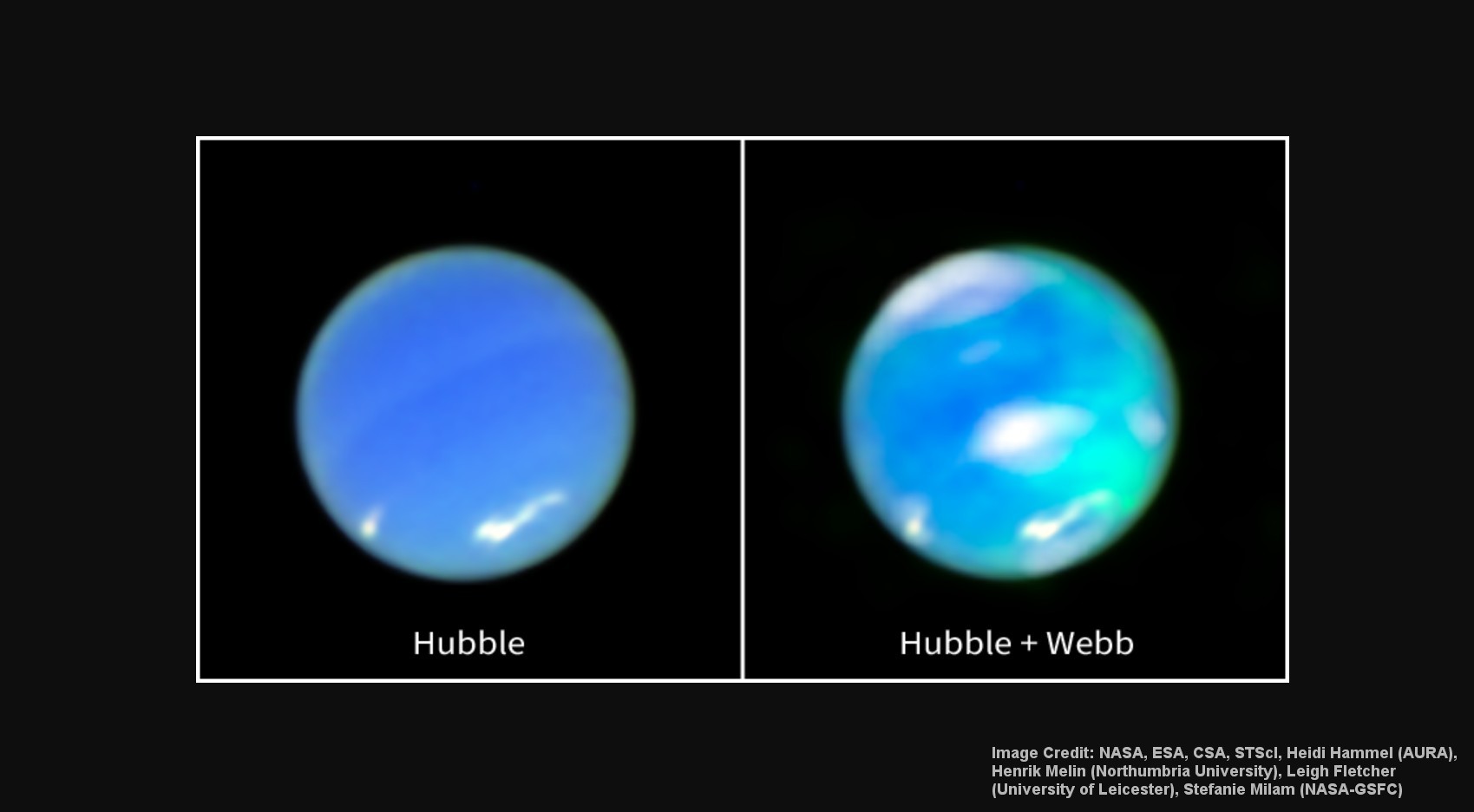
In November 2025 and January 2026, we are undertaking a Grand Tour of Neptune then Uranus. Watching these planets for an entire month, we will see how the aurora of these worlds change across a solar day, as the Solar Wind, filled with regions of compressed and rarefied wind, reaches and distorts the magnetic fields of these worlds. In doing so, we’ll massively improve our understanding of the aurora of Uranus, and for Neptune, we will literally increase the total number of auroral images ten-fold. It is the largest JWST planetary observation ever made: we will be revealing the latest images and talk about what we think we’ve discovered so far.
When the Voyager II spacecraft flew past Uranus and Neptune in 1986 and 1989, respectively, it reveals a strange new type of world, somewhere between the Gas Giants of Jupiter and Saturn, and rocky terrestrial planets like Earth and Mars. These worlds, made from ices for most of their depth, but with deep atmospheres, were unique in their magnetic fields. Unlike Earth’s ‘bar-magnet’ like magnetic field (and the magnetic fields of Mercury, Jupiter and Saturn), these worlds had strangely complex magnetic fields, with four poles, perhaps even eight, magnetic poles (2 north and 2 south). Though unlike anything else in our current solar system, these fields seem to be very much like the fields that Earth itself produced during past magnetic field reversals, making them of great interest in understanding both Earth’s past and the many variant planetary magnetic fields around other stars.
But, since Voyager, these planets have been hidden from view.
A handful of Hubble Space Telescope observations have weakly sampled the UV aurora of Uranus when they are strongest, but we have never observed the aurora of Neptune in the past 35 years. JWST has changed all that – this incredible telescope can not only show these aurora at the edge of our solar system, we instead see brilliant views of both the aurora and the entire surrounding upper atmosphere, laying out not only aurorae but also the magnetic fields across the planet. So far we have observed Uranus twice and Neptune once.
Talks in Person
Professor Tom Stallard will be delivering the SAS talk in person at the Washington Wetlands Centre (Discovery Room).
The talk will also be broadcast via MS Teams (providing there are no technical and/or WIFI difficulties)
Please show you support to our speaker and your Society if you can on the night.
Hopefully, we’ll see you all at the Washington Wetlands Centre (Discovery Room) , a Raffle & Refreshments as usual.
If you haven’t been in a while why not come along and show your support.
Teams Access
When Where Who
- Date: Sunday 18th January 2026,
- Time: 7 pm.
- Speaker: Professor Tom Stallard Northumbria University ,
- Venue: At the Washington Wetlands Centre (Discovery Room ) and Via Teams (Video Streaming Link).
Our speaker
- Tom started his research history completing a PhD in Planetary Astronomy at University College London in 2001. He worked as a research associate there until 2007.
- In 2007, he became an RCUK academic fellow at the University of Leicester. In 2012, he was promoted to Associate Professor there and in 2021, he became the College of Science and Engineering Graduate Director of Postgraduate Research.
- In 2022, he moved to Northumbria University to become a Professor of Planetary Astronomy in the Solar and Space Physics group.
Research Themes and Scholarly Interests
- Tom Stallard is a planetary astronomer who utilises a combination of ground-based telescopes and instruments on spacecraft to understand the upper atmospheres and ionospheres of the giant planets.
- This region of the atmosphere is fascinating because, within its thin air, we see the coupling between two grand systems. At the Sun, the driving forces that dominate the upper atmosphere come from beneath. At Earth, it is the Solar Wind outside the planet that forces energy down into the top of the atmosphere. At the giant planets, because the ionosphere collides with the neutral atmosphere, but carries and is carried by currents from the surrounding magnetosphere, these two chaotic, massive systems are forced to interact. By measuring this interaction, we can reveal the complicated nature of giant planet atmospheres, but also better understand this complex interaction in places where the atmosphere or magnetosphere typically dominate.
- Beyond this work measuring the upper atmospheres of Giant Planets, he also plays an important role in the development of such missions, from driving the scientific programme before launch, through ongoing mission planning, and the detailed calibration and analysis of this data.
- More broadly, he is also interested in understanding the development of life within the universe, as well as exploring how intelligent life might develop in comparison to the Anthropocene on Earth. He also works to understand and improve PhD supervision within Physics.
Your host : Martin Kennedy