
In this talk Dr Julian Onions (Nottingham University) will give an insightful introduction We hear a lot about dark matter in astronomy. Some people consider it a fudge. In this talk we’ll go through the evidence for dark matter and the history of it, and answer the questions in the title. No particular prior knowledge is assumed.
When we look up at the night sky through our telescopes, we are seeing baryonic matter—stars, gas clouds, planets, and dust that emit, reflect, or absorb light. However, all that visible stuff makes up only about 5% of the universe. Roughly 27% of the universe is composed of Cold Dark Matter (CDM). Together with Dark Energy (68%), it forms the backbone of modern cosmology.
What Does “Cold” and “Dark” Actually Mean?
- Dark: It does not interact with the electromagnetic spectrum in any way. It produces no radio waves, visible light, or X-rays, and it doesn’t block or scatter light passing through it. We only know it is there because of its gravitational pull on visible objects.
- Cold: In astrophysics, “cold” means moving much slower than the speed of light. Because these particles move slowly, gravity can pull them together into clumps rather than letting them stream away into space.
Why Observational Astronomers Care About CDM
Without Cold Dark Matter, the night sky would look entirely different—or wouldn’t exist as we know it at all:
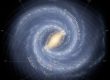
- Galactic Rotation Curves: When we measure how fast stars orbit around galactic centers (such as in Andromeda or our own Milky Way), stars at the outer edges move far too fast. Without extra unseen mass holding them in, these galaxies would fly apart.
- Gravitational Lensing: When light from distant background galaxies passes near a massive galaxy cluster, the path of the light is bent by the cluster’s gravity. The amount of bending reveals vastly more mass than the visible stars and gas can account for.
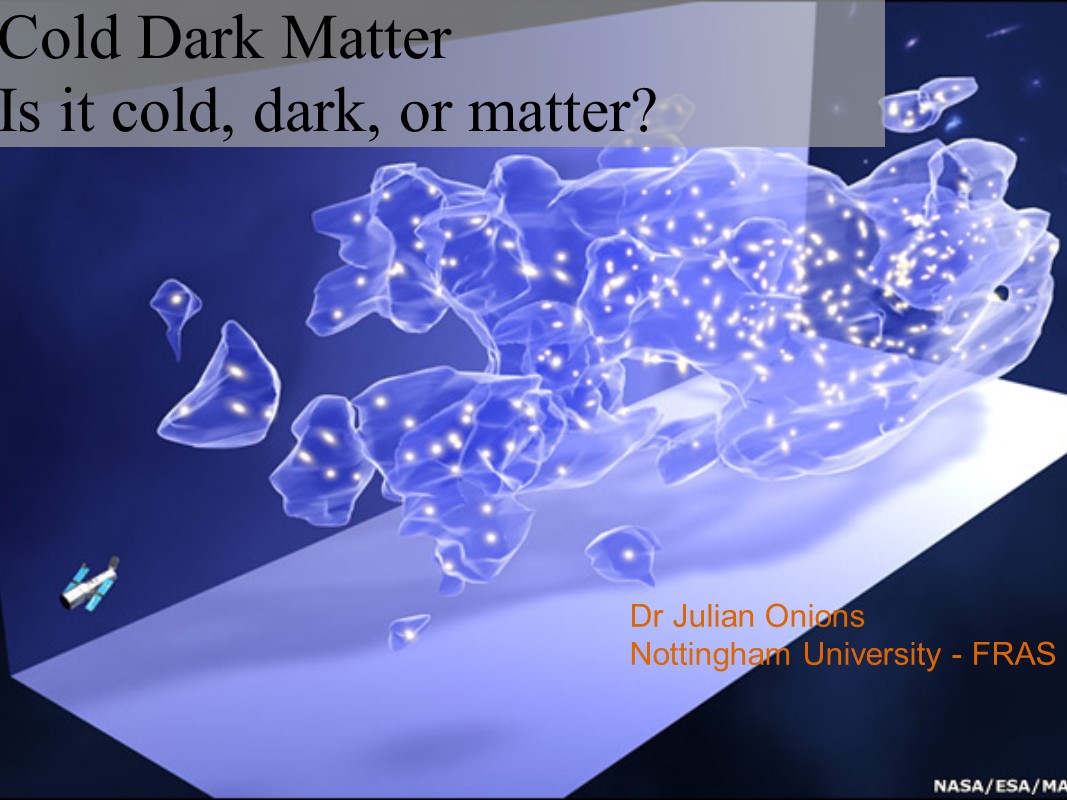
- The Cosmic Web: In the early universe, cold dark matter clumped together first under gravity, creating giant invisible “halos” and filaments. Regular gas then fell into these gravitational wells, collapsing to ignite the very first stars and build the galaxies we observe today.
Talk via Teams at Wetlands Centre
This walk will be held via Teams and shown at the Washington Wetlands Centre (Discovery Room) to get the best to get the best experience from the talk & Q&A..
Please show you support to our speaker and your Society if you can on the night.
Hopefully we’ll see you all at the Washington Wetlands Centre (Discovery Room) , a Raffle & Refreshments as usual.
Teams Access
Join: https://us.list-manage.com/9D3
Meeting ID: 375 442 390 297 76
Passcode: og3Kk2xj
Dr Julian Onions will be delivering the talk via Teams at the Wetlands Centre (Discovery Room), we will broadcast via MS Teams (providing no technical and/or WIFI difficulties)
When Who Where
- Date: Sunday 18th October 2026,
- Time: 7pm.
- Speaker: Dr Julia Onions
- Venue: Given at the Washington Wetlands Centre (in the Discovery Room) and via Zoom (usual Zoom joining instructions), but please do try an attend in person if possible to show support for YOUR Society and our speaker Dr Julian Onions.
Our speaker
Dr Julian Onions. Astrophysicist, Post Doctoral Researcher & programmer
Julian works with computer simulations of large fractions of the universe to understand trends in galaxy formation and evolution.
Investigating the tools that help us form and analyse such simulations such as halo finders, tree builders and semi-analytic models.
He also does a number of outreach activities, giving talks to astronomy societies and other interested groups such as rotary and U3A, as well as working with schools and scouts/guide groups. He also helps with the teaching of undergraduates in some of the astronomy courses.